
A river city on the bluffs since 1854
Concrete Contractors in Sioux City, IA
Driveways, patios, walks and slabs poured for a city with hills, river bottoms and freeze-thaw winters.
- A site visit before any price: we check grade, runoff and what the old concrete is sitting on
- Quotes in writing, with slab thickness, base depth, steel and joint layout spelled out
- City sidewalk notices, right-of-way permits and pre-pour inspections sorted out before the truck is booked
Concrete Work Across Sioux City
Sioux City is where Iowa, Nebraska and South Dakota meet, and our concrete contractors work across the whole city, from the old Northside streets to the newer edges of Morningside. The city covers about 60.5 square miles where the Big Sioux River meets the Missouri. It counted 85,797 residents in the 2020 census and 34,331 housing units. That is a lot of driveways, front walks and back patios, and they sit on very different ground from one neighborhood to the next.
Hills on one side, river bottoms on the other
The city was laid out in the winter of 1854 to 1855 at the head of navigation on the Missouri River. Stone State Park, in the northwest corner of the city, sits near the northern end of the Loess Hills. Loess is a fine, wind-blown silt. It is hard when dry and loses its strength when it gets soaked. On a sloped lot, that means the base under a driveway or a set of steps has to be compacted well and kept dry with good drainage. Water that runs under a slab carries fine soil away and leaves a void.
Down on the flats the challenge is different. Pulaski Park in western Morningside is built on the filled bed of Half Moon Lake, which was created in the 1890s. Filled ground can keep settling for years. When we price a slab on low or filled ground, we look at how much base material it needs before we talk about finishes.
What a Sioux City winter does to a slab
Climate records for the city show a January average low of 10.4 degrees and about 17 nights a year at zero or colder. Average snowfall is 36 inches, and the freeze window runs from about October 1 to April 26. Every thaw lets water into small cracks and pores, and every refreeze pushes them wider. That is why we use air-entrained concrete for every outdoor pour. The tiny air bubbles give freezing water room to expand without spalling the surface.
Timing matters too. We plan exterior pours so new concrete has time to cure before hard freezes, and we tell you to skip rock salt and other deicers for the first winter. Sand works for traction while the surface gains strength.
Permits and levees in the city
The city's Inspections and Permit Services office, part of Community Development, handles building permits. Its FAQ lists accessory structures such as garages over 120 square feet, and retaining walls over 48 inches tall, as projects that need a permit. If you are adding a garage or a large shed, the slab is part of that permitted project, and we plan around it.
The city also requires a permit for below-ground work within 500 feet of the top of a levee, and it names sidewalks and paving in that list. The city's levee system runs along its river frontage, so we check your address against it before we schedule a pour.
Matching the job to the house
The Northside has long been known for its Victorian mansions, and the walks and steps in front of older houses there are often the oldest concrete on the block. Those jobs are usually tear-out and replacement: heaved sidewalk panels, crumbling steps and front walks that trap water against the foundation. Newer streets on the edges of town ask for different things, like wider driveways, a stamped patio off the back door, or a slab for a shed.
- Concrete driveways: sized for your vehicles, with a thicker section where trucks turn in
- Concrete patios: sloped away from the house so meltwater does not pond at the foundation
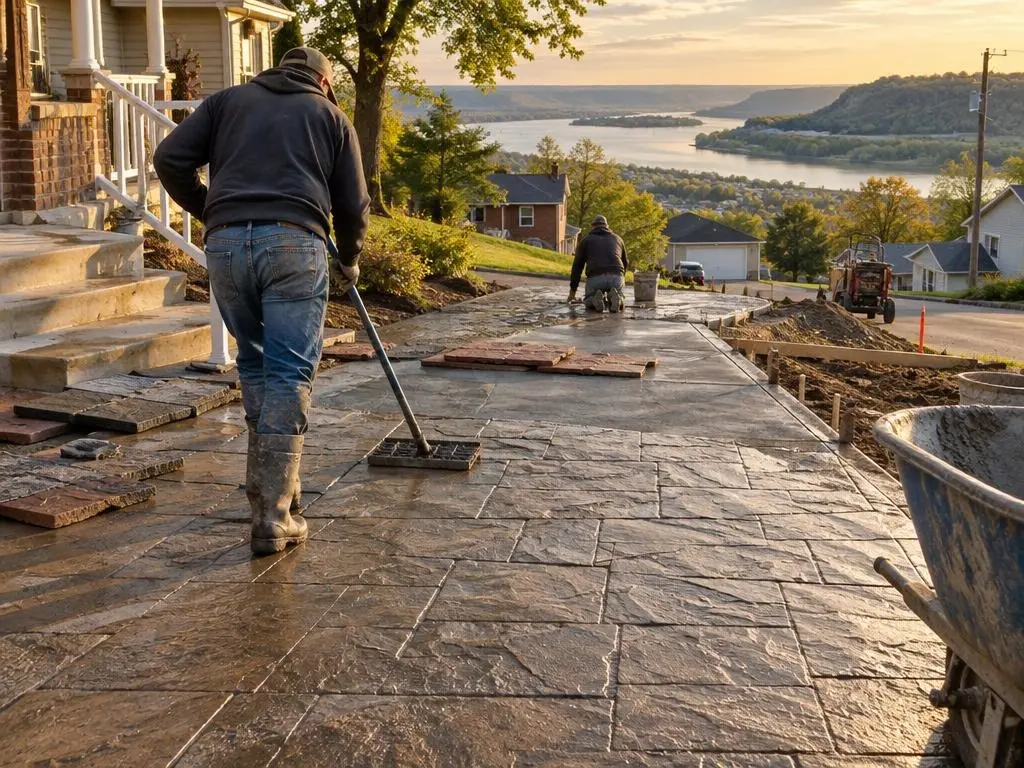
- Stamped concrete: patterns and color for patios and walks, sealed for winter
- Sidewalks and steps: replacement of trip hazards and broken stairs
- Garage and shed slabs: thickened edges and proper base for the load
- Concrete repair and replacement: honest advice on whether to patch, level or start over
How we quote
We come out, measure, look at the grade and drainage, and check what is under the old slab if there is one. You get a written estimate that lists tear-out, base work, reinforcement, finish and sealing as separate lines, so you can see where the money goes. Call (712) 482-2303 or send the form, and tell us what you want poured and roughly where on your lot.
Sioux City Facts That Affect Concrete
- Cold, snowy winters. The January average low is 10.4 degrees, about 17 nights a year reach zero or below, and average snowfall is 36 inches.
- Levee permit zone. Below-ground work within 500 feet of the top of a city levee, including sidewalks and paving, needs a city permit.
- Garage permits. The city's Inspection Services FAQ says accessory structures such as garages over 120 square feet need a permit.
- Loess and filled ground. Stone State Park sits near the north end of the Loess Hills, and Pulaski Park is built on the filled bed of Half Moon Lake.
Our Services in Sioux City, IA
Sioux City Questions
Do I need a permit to replace my driveway in Sioux City?
It depends on where you live and what else is in the project. Paving within 500 feet of the top of a city levee needs a permit, and a new garage over 120 square feet needs one too. For other work we call Inspections and Permit Services at 712-224-5216 and confirm before we start.
When is it too cold to pour concrete in Sioux City?
The freeze window here runs from about October 1 to late April. We can pour into fall with blankets and the right mix, but we watch the overnight lows closely. Concrete must not freeze before it gains strength, so we will move a date rather than risk it.
My house is on a hill. Will that change the job?
Yes. Sloped lots in the bluffs need more attention to drainage and base compaction, because the local loess soil weakens when wet. We may add steps, a landing or a drain to keep water from running under the slab.
Free Estimates in Sioux City, IA
Free on-site estimates from the Northside to Morningside.
Concrete Contractors Near Sioux City
- Concrete Contractors in South Sioux City, NE
- Concrete Contractors in North Sioux City, SD
- Concrete Contractors in Dakota Dunes, SD
- Concrete Contractors in Sergeant Bluff, IA
- Concrete Contractors in Le Mars, IA
- Concrete Contractors in Dakota City, NE
- Concrete Contractors in Elk Point, SD
- Concrete Contractors in Jefferson, SD
- Concrete Contractors in Hinton, IA
- Concrete Contractors in Lawton, IA
- Concrete Contractors in Moville, IA
- Concrete Contractors in Sloan, IA
- Concrete Contractors in Homer, NE
- Concrete Contractors in Akron, IA
- Concrete Contractors in Kingsley, IA
- Concrete Contractors in Merrill, IA
- Concrete Contractors in Salix, IA
- Concrete Contractors in Ponca, NE
- Concrete Contractors in Jackson, NE