
Driveways, patios, sidewalks, steps and slabs
Concrete Contractors in Sioux City, IA
New concrete and repairs built for loess soil, Siouxland hills and hard Iowa winters.
- A site visit before any price: we check grade, runoff and what the old concrete is sitting on
- Quotes in writing, with slab thickness, base depth, steel and joint layout spelled out
- City sidewalk notices, right-of-way permits and pre-pour inspections sorted out before the truck is booked
Concrete Built for Sioux City Ground and Winters
Concrete contractors in Sioux City deal with ground that changes from one block to the next. The city sits at the northern end of the Loess Hills, where wind-blown silt in Iowa often runs more than 90 feet deep, and its streets climb from the Missouri River bottoms into Morningside, Rose Hill, the Northside and the Heights. Mix in about 36 inches of snow a winter and a long run of nights below freezing, and you get driveways that heave, walks that drop and stoops that shed their surface. We pour new concrete and repair old concrete with those conditions in mind.
Why slabs give out in this town
Five causes account for most of the cracked, tipped and flaking concrete we are asked to look at:
- Washed-out base. Loess is called "sugar clay" locally because it is rock-hard when dry and loses its cohesion when wet. Runoff that slips under an edge carries the fine silt away, leaves a hollow, and the slab settles into it.
- Freeze and thaw. Sioux City climate records show a January average low around 10 degrees, roughly 52 days a year that never get above freezing, and about 17 nights at zero or below. Moisture in the top of the slab freezes, swells and lifts off flakes.
- Road and sidewalk salt. Deicers speed up that scaling, and young concrete in its first winter is the most vulnerable.
- Hills. On a sloped lot, roof water, yard water and street runoff all head downhill to the lowest slab. Without a planned path, the water ends up underneath it.
- Age. About a third of Sioux City homes date from 1939 or earlier, and the median house was built in 1957. Many of the walks and steps in front of them are just as old.
What we do about it
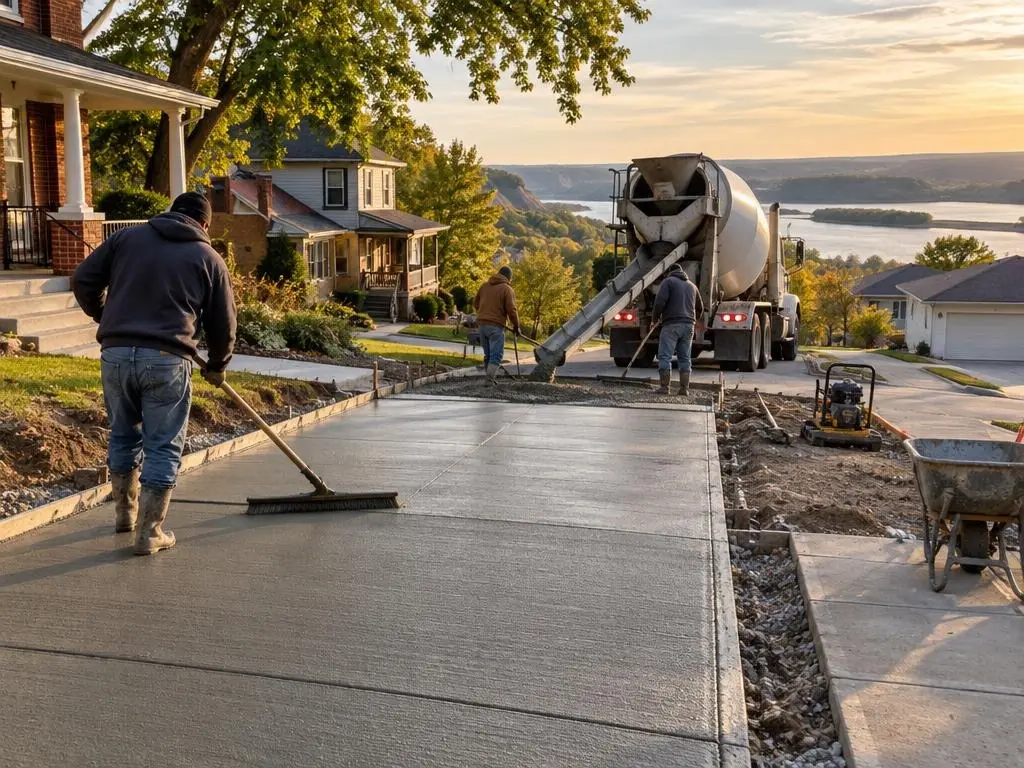
The work starts below the slab. Old concrete comes out, soft or wet soil is dug out, the subgrade is compacted and a gravel base goes in. Exterior pours use air-entrained concrete, whose microscopic air voids give freezing water somewhere to go. Forms are set so the finished surface falls toward the lawn or the street, away from the foundation. Steel goes in where the soil or the load calls for it, and control joints are cut so shrinkage cracks run along a line we chose instead of across the middle of a panel.
Public sidewalks and the city
In Sioux City, the owner of the adjoining lot is responsible for fixing unsafe public sidewalk. The Engineering Division splits the city into ten zones and inspects one a year, marking panels with problems such as a lip or gap of 3/4 inch or more. An owner can hire a contractor of their choosing, who pulls a city permit, and the city inspects the forms before the pour. The same division also issues driveway and sidewalk installation and replacement permits. We take care of that paperwork and book the inspection as part of the job.
The six things we build
- Driveways, from a single-car strip off an alley to a wide three-car approach, including tear-out.
- Patios with a broom, colored, exposed aggregate or stamped surface.
- Stamped concrete on patios, front walks and driveway edges.
- Sidewalks and steps, including panels marked on a city notice and front stoops.
- Garage floors and shed pads, with thickness and base matched to what sits on them.
- Repair and replacement of cracked, sunken or scaling concrete, with a straight answer on which one you need.
Looking after new concrete
A new slab is not done when the forms come off. Hold cars off a new driveway for roughly seven days, and skip ice melt for the whole first winter. The city's Engineering Division passes on Iowa Concrete Paving Association advice to use plain sand instead on driveways and sidewalks poured that season. Once the slab has cured, a penetrating sealer, reapplied every few years, keeps brine and water from soaking into the surface. We go over the care plan for your slab before we leave.
Why Homeowners Call Concrete Contractors Sioux City
The base comes first
Soft soil is dug out and gravel is compacted before forms go up. On loess, most failed slabs failed from below.
Made for winter
Exterior concrete is air entrained and pitched to shed water, since freeze-thaw and salt cause most surface damage here.
Line-item quotes
Thickness, base, steel, finish and price each get their own line, which makes comparing bids simple.
City paperwork covered
Sidewalk notices, right-of-way permits and pre-pour inspections are lined up before the pour date.
Where We Work
Inside Sioux City we work from the Northside and the Heights to Morningside, Rose Hill, Southern Hills and the West Side. Outside the city limits we cover Sergeant Bluff, Salix and Sloan to the south; Le Mars, Hinton, Merrill, Akron and Kingsley to the north and east; Lawton and Moville out along Highway 20; South Sioux City, Dakota City, Jackson, Homer and Ponca across the river in Nebraska; and North Sioux City, Dakota Dunes, Jefferson and Elk Point in South Dakota. Live nearby but not on the list? Call (712) 482-2303 and ask.
- Concrete Contractors in Sioux City, IA
- Concrete Contractors in South Sioux City, NE
- Concrete Contractors in North Sioux City, SD
- Concrete Contractors in Dakota Dunes, SD
- Concrete Contractors in Sergeant Bluff, IA
- Concrete Contractors in Le Mars, IA
- Concrete Contractors in Dakota City, NE
- Concrete Contractors in Elk Point, SD
- Concrete Contractors in Jefferson, SD
- Concrete Contractors in Hinton, IA
- Concrete Contractors in Lawton, IA
- Concrete Contractors in Moville, IA
- Concrete Contractors in Sloan, IA
- Concrete Contractors in Homer, NE
- Concrete Contractors in Akron, IA
- Concrete Contractors in Kingsley, IA
- Concrete Contractors in Merrill, IA
- Concrete Contractors in Salix, IA
- Concrete Contractors in Ponca, NE
- Concrete Contractors in Jackson, NE
Concrete Services
Each service below is quoted after a site visit, in writing, line by line.
Concrete Driveways
New driveways and full tear-out replacements with a compacted base, air-entrained mix and slope that sheds water.
Learn more →Concrete Patios
Back and side-yard patios in broom, colored or exposed aggregate finishes, pitched away from the house and sized to how you will use them.
Learn more →Stamped Concrete
Patterned and colored concrete that looks like stone, slate or brick, poured and stamped as one slab.
Learn more →Sidewalks & Steps
Public sidewalk panels, front walks and concrete steps, including repairs from City of Sioux City sidewalk notices.
Learn more →Garage & Shed Slabs
Garage floors and slabs for sheds, workshops and outbuildings, with the thickness and base matched to the load.
Learn more →Concrete Repair & Replacement
Cracked, sunken or flaking concrete assessed honestly: crack repair, leveling or tear-out and replacement.
Learn more →
Common Questions
What does a concrete contractor do?
They get the ground ready, set forms, place steel, then pour, finish, joint and cure the concrete. For a homeowner that usually means driveways, patios, walks, steps, garage floors and shed pads, plus breaking out and replacing concrete that has failed. Much of the job is done before any concrete shows up: digging, base work, grading and forming.
What is concrete made of?
Portland cement, water, sand and coarse aggregate such as gravel or crushed rock. Water and cement react and harden, locking the sand and stone together. Outdoor concrete in Iowa also gets an air-entraining admixture, which spreads tiny bubbles through the paste so freezing water has room and the surface does not scale.
How much does a concrete driveway cost in Sioux City?
HomeGuide's national cost guide lists plain concrete driveways at $6 to $10 a square foot. For a 20 x 20 two-car driveway (400 square feet) that works out to roughly $2,400 to $6,000, and tearing out an old one adds $2 to $6 a square foot. Grade, access and thickness move the number, so we measure before we quote.
Who has to repair the public sidewalk by my house?
In Sioux City it is the owner of the adjoining property, under Iowa Code and city code. The Engineering Division inspects one zone of the city each year. You can hire a contractor of your choice, who works under a city permit with an inspection before the pour, or have the city's contractor do it and send you the bill.
Is a permit needed to redo a driveway or sidewalk?
Inside Sioux City, the Engineering Division issues driveway and sidewalk installation and replacement permits for work in the public right-of-way, which covers the approach at the street and the public walk. Other towns set their own rules. We confirm what applies at your address before a pour date is set.
When can you pour concrete in Sioux City?
Most flatwork goes in between spring and fall. Cold-weather pours are possible with heated water, insulated blankets and accelerators, but they cost more, and a late-season slab meets salt and freeze-thaw before it has much strength. We watch the forecast and will tell you if a job is better left until spring.
Can I use salt on new concrete?
Not during its first winter. Citing the Iowa Concrete Paving Association, the city's Engineering Division recommends plain sand instead of ice melt on driveways and sidewalks put in that construction season. After that, shovel early, use deicer sparingly and keep the surface sealed.
Get a Written Concrete Estimate
Describe the driveway, patio, walk, steps or slab. We will come out, measure and put an itemized quote in writing.